Posts

possible or not

  Originally published on Language and Philosophy, May 10,2012 Is it possible to swim the Atlantic? An ex neighbor points out that if “possibly” doesn’t imply also “possibly not” then how is “possibly” different from necessity? Doesn’t “Life on Mars is possible” mean “It’s also possible that there’s no life on Mars”? And doesn’t it also mean “Life on Mars isn’t necessary”? Grice gave an answer to this question, and I’ve written about it elsewhere in this blog, but I think there’s more to be said and I want to try to sort all of them out. Suppose Goldbach’s postulate is possibly true. Suppose someone proves it. Now it’s necessarily true. Is it no longer possibly true? My neighbor says no. I think Lukasciewicz agreed with him. But suppose we have a set of conditions that fulfill the capacity to swim the Atlantic, and some person satisfies that set. Now it’s possible for someone to swim the Atlantic, and the question of whether it has been done is irrelevant. One way to cash out the n...
Aymara, trivalence, competing satisfaction and modality

  Originally published on Language and Philosophy, January 6, 2012 In his monograph on the trivalent logic of Aymara, Ivan Guzman de Rojas sets out to show that a trivalent logic can reach conclusions unavailable to bivalent logic. I want to tease out the import and accuracy of this extraordinary claim, and try to understand its significance for modal logic. Consider two circumstances: p) there’s smoke; q) there’s fire. And consider these two premises: X) if there’s smoke, there’s fire; ¬p) there’s no smoke. From these two premises in a bivalent logic using the standard definition of implication, you can conclude that (X) is true, but no conclusion can be reached as to whether (q) holds or not. Using a Rojas matrix: p  T   |  T  |  F  |  F q  T  |  F  |  T  |  F X  T  |  F  |  T  |  T ¬p F  |  F  |  T  |  T The third and fourth columns refle...

language and logic, English and Aymara

  Originally published on Language and Philosophy, January 5, 2012 Following up on the last post — If English were incapable of expressing ternary logic, then Aymara could not be described in English. It does not seem too contentious, then, to conclude that any natural language, like English, Spanish (Rojas’ original) or Aymara, can express any known logic. The means will no doubt differ: analytic languages would express notions of uncertainty with word-morphemes (like “might”); agglutinative and inflectional languages should express them with affixal morphemes. The notions seem to drive the languages, not the other way around. For example, German has a past tense conjugation for the equivalent of English “must.” English doesn’t. Instead, English uses “had to.” No one would conclude that English speakers are at a loss for the notion. Rather, the pervasive usefulness of the notion has compelled English speakers to formulate an analytical combination that has every mark of a modal ex...

Aymara

  Originally published on Language and Philosophy, January 4, 2012 I see that Wikipedia’s article on ternary logic references Aymara “a Bolivian language famous for using ternary rather than binary logic.” Aside from the vaunted adjective “famous,” I am skeptical of the claim that Aymara uses a ternary logic rather than binary, skeptical also of the presupposition that natural languages use a particular logic rather than another logic, and skeptical as well of the implicature that other languages use only binary logic, infamously or otherwise. Much of the excitement over Aymara derives from a monograph written  in the 1980’s by an engineer and machine translation pioneer, Ivan Guzman de Rojas, who observed that Aymara indicated in its inflections the degree of certitude of its respective assertions. He takes these as logical operators, just as “not” can be taken in English as a negation operator: in English, “not” takes a true statement into a false one, and a false one into a...

fun with Gödel

Image
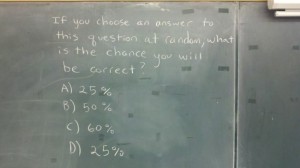
  Originally published on Language and Philosophy, November 3, 2011 There’s an easy answer to this question, but if you replace c) 60% with 0%, then you get a liar paradox, a Gödel-type statement — it has no numerical answer and can only be evaluated outside its terms. http://flowingdata.com/2011/10/28/best-statistics-question-ever/ Gödel, btw, once proved Anselm’s ontological argument, the argument that proves god exists. His version, so far as I can tell, removes all modality in Anselm’s argument, and I think that’s why it works. It’s a complicated version, but I think that even extremely simple, non modal versions work too, e.g., if “god” by definition is that which nothing is greater, then whatever is greatest is that thing. This version works for any model in which there is at least one object. So if nothing exists, then it doesn’t prove anything, but since something patently exists, we can safely assume that there is a greatest thing. It’s been pointed out to me that there ma...

mixing speech with contextual logic

  Originally published on Language and Philosophy, October 29, 2011 Geach and Horwich both criticise Strawson’s performative analysis of the truth predicate in English on grounds that seem to me not only mistaken, but a common mistake, really a category error, conflating the speech situation with logic uncontextualized — the logic you study in college. Not just a common mistake, it’s just about everywhere. Here’s their argument: If Strawson is right that the truth predicate is some kind of gesture of agreement, then accepted deductive arguments will fail, e.g., 1. Phil’s claim is true 2. Phil’s claim is that snow is white 3. conclusion: snow is white. If (1) means that the speaker is agreeing with Phil’s claim, then there’s no deduction from the speaker’s agreement to the fact in the conlcusion. At best, the argument concludes that the speaker agrees that snow is white. But even that wouldn’t hold, since agreement, like belief, is probably an opaque context — imagine a speaker who ...

Everything and More

  Originally published on Language and Philosophy, April 9, 2011 Btw, Wallace’s book on infinity, Everything and More, is an excellent, lucid treatment of the problems within mathematics (which implies scientific theory in general) and its application to the real world. There are limits at the boundaries not only of mathematics, but also in logics — not only modal logics but even simple first order logic. Reminds me of a Kantian remark Russell made somewhere to the effect that our descriptions of phenomena only approach the phenomena from our descriptive perspective. The things themselves remain utterly mysterious. Worse, our descriptive apparatus is limited. Even ourselves as phenomena (pace Schopenhauer) cannot gain access to ourselves beyond our own descriptive apparatus — language, sensibility, logic and science. We can, at best, observe behavior and derive a few conclusions. Schopenhauer, prior to Darwin and armed only with Eastern religion, mistook that behavior for the thin...